The Evolution of Personas
For years, personas have supported businesses to humanize their audiences. Traditionally, these personas were research-driven but static, frozen in time. With the rise of generative AI, synthetic personas (avatar-led) have become fast, scalable, and engaging. But realism doesn’t guarantee accuracy. A more advanced approach is now taking hold: evidence-based personas built on real-life data and signals, optimized with synthetic data. These personas are not just storytelling tools, they are predictive systems that help forecast behavior and inform decisions.
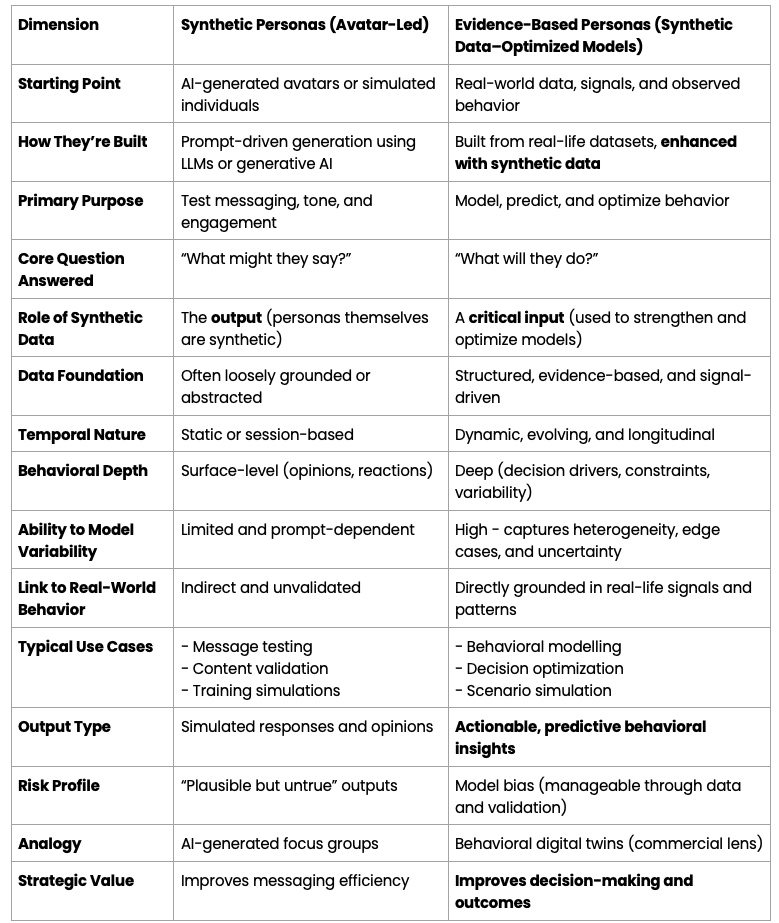
Synthetic Personas vs Evidence-Based Personas: Key Differences
Depth, Variability, and Realism
- Behavioral Depth: Synthetic personas capture surface-level opinions and preferences, while evidence-based personas delve into decision drivers, constraints, and behavioral variability
- Ability to Model Variability: Synthetic personas are limited and heavily dependent on prompts. Evidence-based personas capture heterogeneity, edge cases, and uncertainty at scale
- Link to Real-World Behavior: Synthetic personas are indirect and largely unvalidated. Evidence-based personas are directly tied to real-life signals and behavioral patterns.
Use Cases and Outputs
- Synthetic Personas: Ideal for message testing, content validation, and training simulations. They generate simulated responses and opinions
- Evidence-Based Personas: Suited for behavioral modelling, decision optimization, and scenario simulation. They deliver actionable, predictive behavioral insights
Risk and Strategic Value
- Risk Profile: Synthetic personas risk producing “plausible but untrue” outputs. Evidence-based personas may introduce model bias, but this can be managed through rigorous validation and data governance
- Analogy: Synthetic personas resemble AI-generated focus groups, while evidence-based personas function as behavioral digital twins with a commercial lens
- Strategic Value: Synthetic personas improve messaging efficiency; evidence-based personas improve decision-making and real-life outcomes
Why This Shift Matters
As organizations become more data-driven, bridging the gap between insight and action becomes critical. Synthetic personas help teams feel closer to customers, enabling rapid exploration and iteration. Evidence-based personas help organizations act with confidence, supporting strategy, forecasting and optimization. The future is not about choosing one over the other – but knowing when to use each:
- Synthetic personas for exploration, creativity, and quick validation
- Evidence-based personas for strategic decisions, predictive modelling, and optimizing outcomes.
Conclusion
We are moving from a world of imagined audiences to modelled behaviors. The question is no longer: “Does this sound right?” It becomes: “Will this work in the real world?” Organizations that adopt evidence-based personas grounded in real data and strengthened by synthetic inputs may be better positioned to improve decision-making and forecasting than those relying solely on simulated narratives. Ultimately, better decisions come from understanding not just what people say, but what they are most likely to do.
References