From Weight Loss to Liver Health: What Consumer Conversations Reveal About the Emerging MASH Landscape
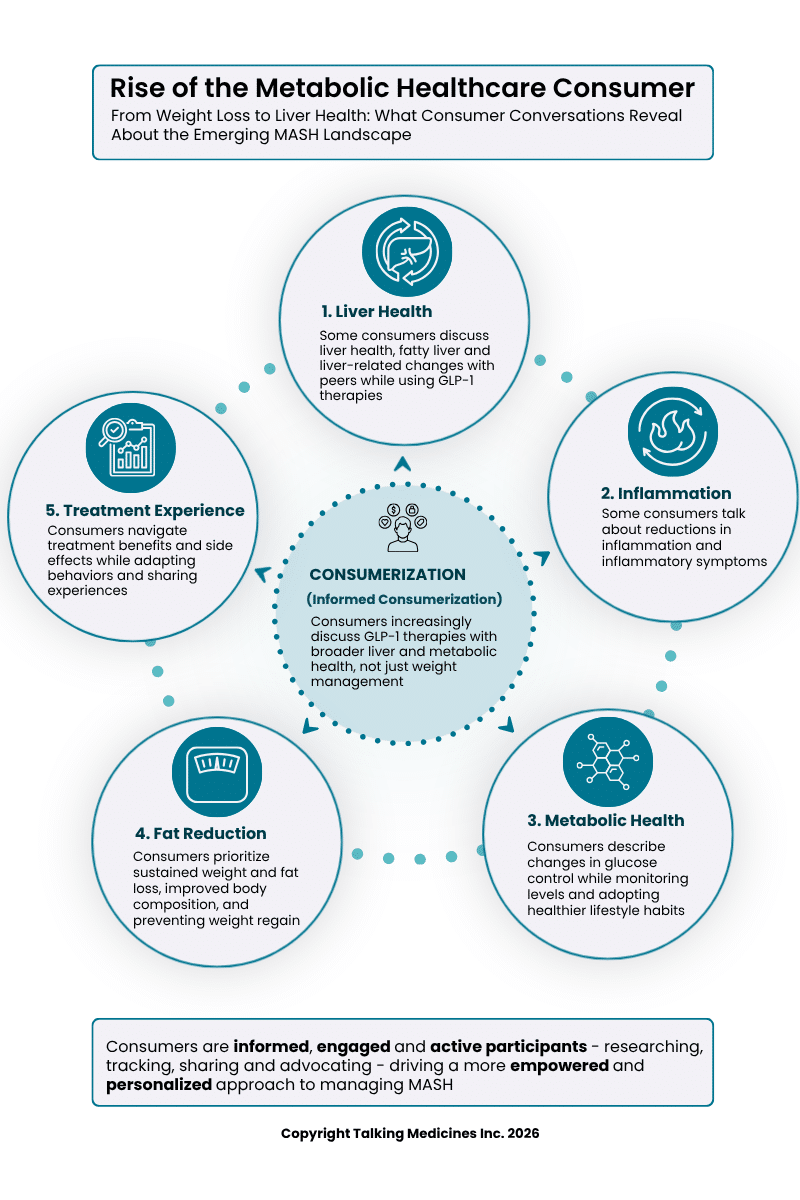
Conversations around GLP-1 therapies are often centered on weight loss, dosage, price, and side effects. Alongside these discussions, some consumers also talk about liver health, inflammation, glucose control, metabolic health, and MASH (Metabolic dysfunction-associated steatohepatitis). Rather than discussing GLP-1 therapies only in the context of obesity, some conversations also reference broader aspects of metabolic health and liver-related changes. These discussions provide insight into the range of topics consumers associate with treatment experiences.
Informed Consumerization in MASH Discussions
Consumer conversations suggest that some people are actively engaging with aspects of their health and treatment experience. Our analysis found discussion relating to:
- Discussing liver health alongside glucose monitoring
- Tracking symptoms
- Comparing treatment experiences with others
- Balancing treatment benefits with side effects
- Adopting lifestyle changes to support overall health
These behaviors are consistent with informed consumerization, where consumers actively participate in conversations about their health and treatment experiences.
Behavior Matters as Much as Conversation
Consumer conversations may provide insight into reported behaviors and experiences. Across MASH-related discussions, consumers describe behaviors such as:
- Tracking symptoms and treatment experiences
- Monitoring glucose and other aspects of metabolic health
- Sharing experiences with peers
- Balancing treatment benefits with tolerability
- Discussing lifestyle changes alongside treatment
These behavioral signals may provide insight into how people discuss treatment decisions and where education and communication opportunities may exist.
What This Means for Life Sciences
Consumer conversations can provide an additional perspective alongside clinical evidence. Understanding behaviors alongside scientific evidence may help organizations to:
- Identify areas where consumers seek further information
- Develop communications that reflect Patient priorities
- Better understand perceptions of liver and metabolic health
- Monitor how consumer discussions evolve over time
- Support evidence-informed Patient engagement strategies
Consumer conversations reflect perceptions and experiences rather than clinical outcomes and should complement, not replace, clinical evidence.
From Conversation to Intelligence
At Talking Medicines, we believe the greatest value lies not simply in listening to conversations but in understanding the behaviors, emotions and motivations that underpin them. Through our Advanced Data Science and AI platform, DrugVoice, we analyze real-life healthcare conversations. This is intended to help organizations explore behavioral patterns, emotional themes, and message resonance within healthcare conversations. This enables organizations to move beyond measuring what is being said to understanding how consumers discuss treatments, respond to health information and engage with disease-related topics. Behavioral intelligence provides an additional source of insight that may complement other evidence and support communication strategies and decision-making across Life Sciences.
Conclusion
Consumer conversations about GLP-1 therapies encompass more than weight loss alone. Alongside discussions of dosage, price, side effects and weight management, some consumers also discuss liver health, inflammation and broader metabolic health. When interpreted alongside scientific evidence, consumer conversation analysis may contribute to a broader understanding of Patient perspectives. While these conversations do not constitute clinical evidence, they provide behavioural intelligence into how consumers perceive treatments, discuss health topics and share experiences. Combined with scientific evidence, consumer conversation analysis can contribute to a broader understanding of Patient perspectives and support more informed, Patient-centred communication strategies.
As consumer understanding of metabolic health continues to evolve, organizations that combine clinical evidence with real-life behavioural intelligence will be best positioned to develop communications that are scientifically robust, Patient-centred and relevant. If you’d like to learn how DrugVoice helps measure consumer behaviors, emotions and message resonance across therapeutic areas such as MASH, we’d be delighted to start the conversation. Book in time with our team here.
Disclaimer: The findings presented are based on analyses of online conversations. They reflect reported perceptions, experiences, and behaviors and should not be interpreted as clinical evidence, treatment outcomes or evidence of efficacy or safety. Social listening data may not be representative of the broader Patient population and should be interpreted alongside clinical research and other evidence sources. The insights in this article are derived from an analysis of social listening data, providing a view of consumer conversations and behaviors related to GLP-1 therapies. Findings represent observed online conversations and should not be interpreted as clinical outcomes or representative of all Patients.
References
- Clinical Assessment and Management of Metabolic Dysfunction-Associated Steatotic Liver Disease
- EASL–EASD–EASO Clinical Practice Guidelines on the management of metabolic dysfunction-associated steatotic liver disease (MASLD)
- EASL MASLD Guidelines Academy: Translating the EASL-EASD-EASO Clinical Practice Guidelines into clinical practice
- Health literacy development for the prevention and control of noncommunicable diseases: Volume 4. Case studies from WHO National Health Literacy Demonstration Projects
- Metabolic Dysfunction-Associated Steatotic Liver Disease (MΑSLD)
- NASH: regulatory considerations for clinical drug development and U.S. FDA approval
- Reflection paper on regulatory requirements for the development of medicinal products for non-alcoholic steatohepatitis (NASH)