In Life Sciences, messaging is strategic. For Med Comms Agencies, the ability to prove that strategy is landing as intended is increasingly under scrutiny. Clients expect more than creative excellence and activity reporting. They expect evidence that communications are aligned and influencing behavior.
The Message Resonance Score™ provides that evidence.
The Message Resonance Score™ quantifies alignment between intended messaging and real-life captured data. Using a 1.0 to 5.0 scale, where 1.0 represents strong misalignment and 5.0 represents strong alignment, it translates qualitative communication into a measurable KPI grounded in observed data.
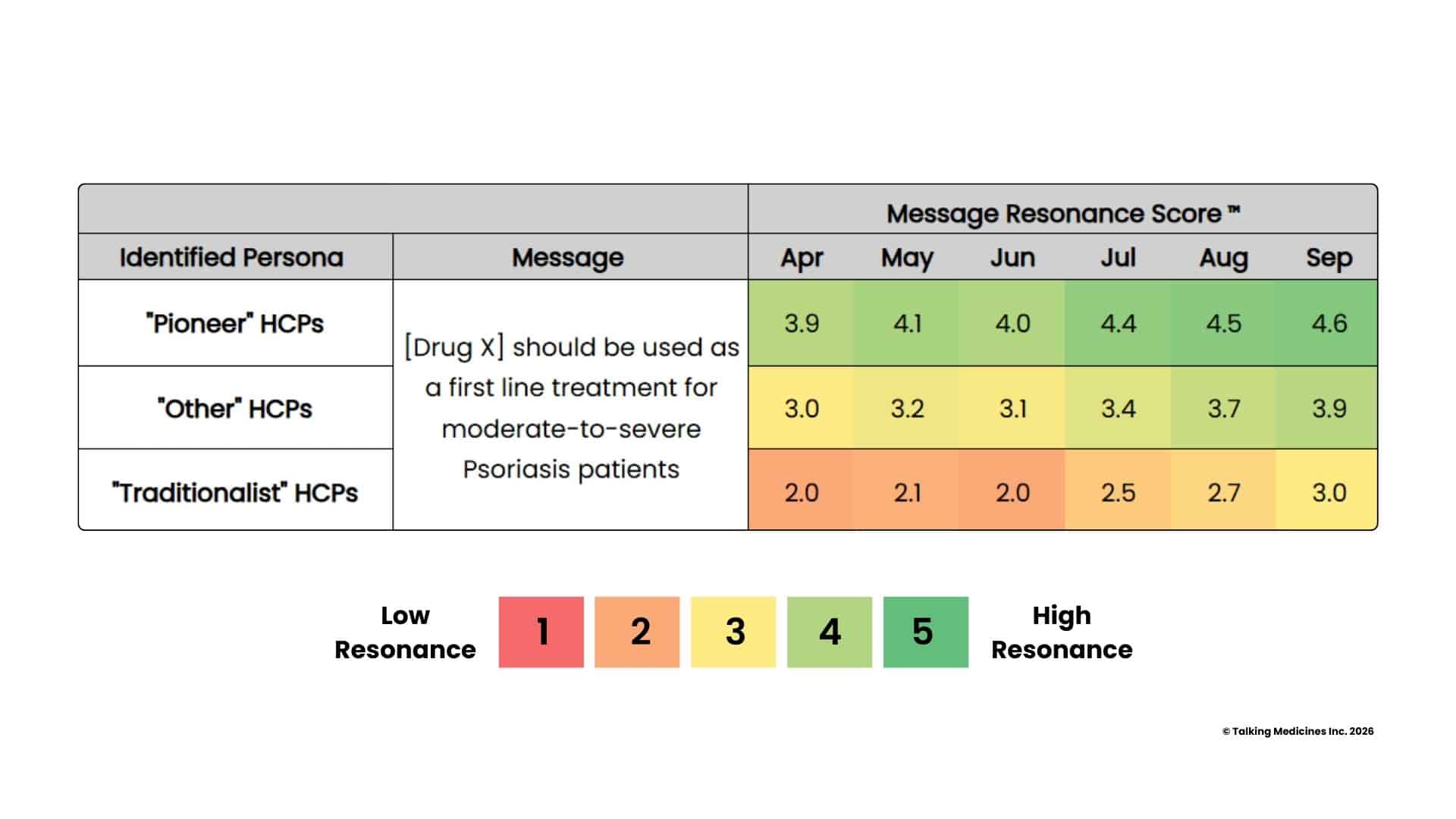
For Agencies, this shifts the conversation from outputs to impact.
Client strategy teams are responsible for ensuring that messaging resonates across audiences, geographies, and stakeholder groups. However, resonance is rarely uniform. Different personas interpret and express messages differently. The Message Resonance Score™ makes that variation measurable.
Consider a strategic message: “Our product is loved by healthcare professionals.”
When analyzed against real-life captured data, resonance may differ significantly by persona:
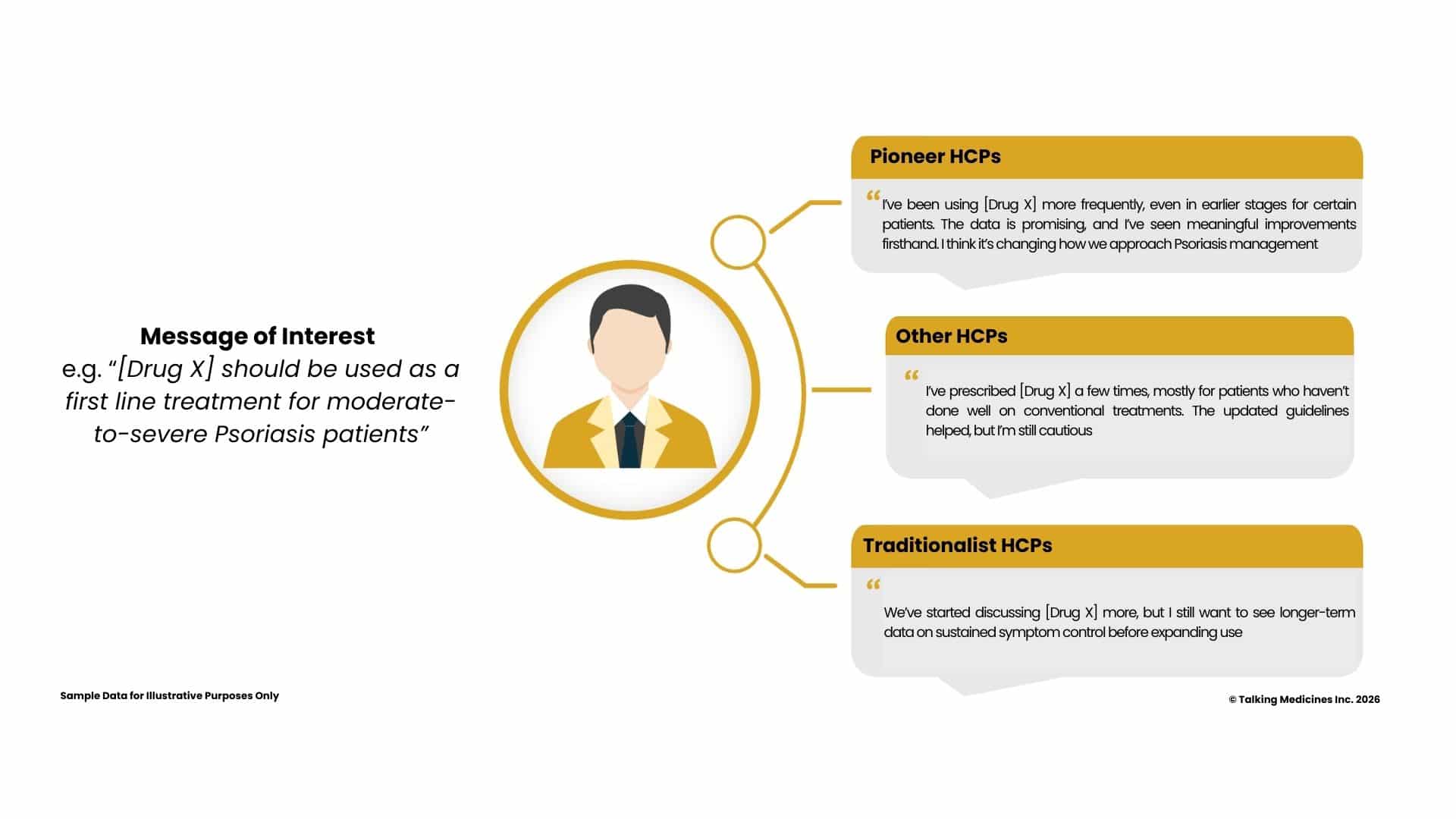
• Pioneer persona: “I love this product!”
Strong alignment. High score of 5.
• Traditionalist persona: “I don’t like this product!”
Strong misalignment. Low score of 1.
• Other persona: “It works okay for some Patients.”
Partial alignment. Mid-range score of 3.
The same intended message can produce materially different levels of resonance depending on the audience segment. Without measurement, this variation remains hidden.

By applying the Message Resonance Score™ at persona level, Agencies can identify where alignment is strong and where intervention is required. This enables more precise refinement of educational materials, and adjustment of campaign narratives.
When an intervention is implemented, such as revised messaging, enhanced training materials, or repositioned scientific emphasis, the Message Resonance Score™ can track movement over time. Persona-level scores before and after intervention provide clear evidence of whether alignment has improved.
For example, a Traditionalist persona initially scoring 1 or 2 can be monitored following messaging refinement. If subsequent analysis shows movement toward 3 or 4, Agencies can demonstrate measurable improvement in resonance. This shifts reporting from activity to documented behavioral alignment.
The ability to visualize persona movement before and after intervention strengthens strategic conversations with client teams. It provides defensible, data-driven proof that communication strategy is not static but optimized based on real-life evidence.
In digital and social environments, where conversations evolve rapidly and audience fragmentation is common, this level of precision is increasingly essential. Identifying underperforming personas, detecting content gaps, and validating improvement over time enhances both credibility and strategic authority.
Ultimately, the Message Resonance Score™ matters because it connects strategy to reality at a granular level. It enables Agencies to quantify how different personas are responding, demonstrate improvement following intervention, and provide clients with measurable evidence of communication effectiveness.
For strategist and client leaders seeking to elevate strategic value and provide clients with defensible proof of impact, the Message Resonance Score™ offers a structured and differentiated approach. Connect with Talking Medicines to explore how persona-level resonance measurement can strengthen your next strategic engagement.