

Part 1: Why the Biggest Challenge Isn’t Technology It’s Translation
Every generation faces a defining challenge. For some, it was access to information. For others, it was the ability to process information. Today, our challenge is different. We have more information readily available than at any point in human history. Scientific discoveries are accelerating. Artificial intelligence (AI) is generating insights at increasing speed and scale. Yet organizations across healthcare, Life Sciences and technology continue to encounter the same problem: People do not always understand information in the way it was intended. The issue is not a lack of data, lack of evidence or lack of intelligence. The issue is translation.
Three Worlds. Three Languages.
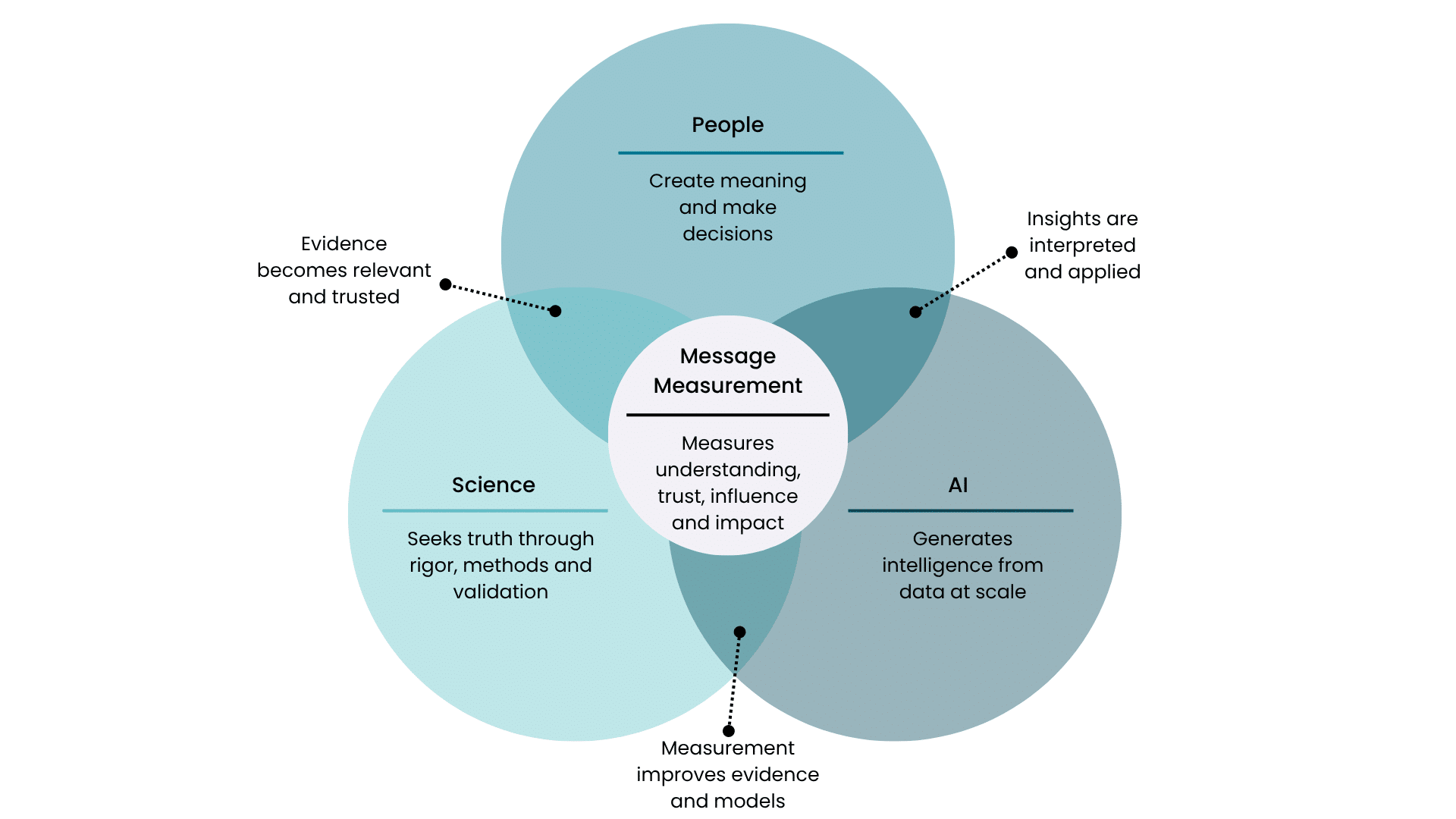
Science, AI and People appear to be pursuing the same objective: understanding. Yet each approaches that objective through a different language. Each interprets information through a different lens, defines value differently, and communicates differently. Understanding these differences may become one of the most important capabilities of modern organizations.
© Talking Medicines 2026
Science Speaks the Language of Evidence
Science seeks to reduce uncertainty through experimentation, observation and evidence generation guided by rigor, validation and reproducibility.
In healthcare and Life Sciences, science drives:
- Clinical discovery
- Therapeutic innovation
- Treatment validation
- Outcome measurement
Science is essential because it helps us build evidence-based understanding of the world. However, scientific evidence often speaks a language that can be difficult for broader audiences to interpret. For example, research findings are frequently expressed through probabilities, statistical significance, confidence intervals and clinical outcomes. For scientists, this language is familiar. For many audiences, it is not.
The challenge is not generating evidence. The challenge is ensuring evidence becomes understanding.
AI Speaks the Language of Patterns
AI operates differently. Unlike scientific inquiry, AI systems are designed to identify statistical relationships and generate outputs based on patterns in data rather than independently establishing scientific truth. Instead, it identifies relationships, patterns, signals, predictions. It analyses large volumes of information and can help identify patterns or relationships that may be difficult for humans to detect at scale.
Across healthcare and life sciences, AI is increasingly helping organizations:
- Analyze Patient experiences
- Understand market dynamics
- Identify emerging trends
- Improve operational efficiency
- Generate predictive insights
AI excels at scale, at speed and at finding connections. Yet AI does not inherently understand meaning. It understands data. The challenge is transforming AI-generated intelligence into something people can trust and act upon.
People Speak the Language of Meaning
People process information differently from both science and AI. Human decision-making is influenced not only by facts, but also by context, experience, emotion, trust and personal circumstances.
People ask different questions:
- Can I trust this?
- Does this affect me?
- Does this align with my experience?
- What does this mean for my future?
This is particularly important in healthcare. Patients experience healthcare through personal interactions, outcomes and lived experiences rather than through data alone. Healthcare professionals do not simply consume evidence. They interpret it through clinical judgement and Patient need. People derive meaning from information, and that meaning shapes behavior.
The Cost of Misalignment
The challenge arises when these three worlds fail to connect.
- Scientific evidence may be robust but poorly understood
- AI-generated insights may be accurate but poorly trusted
- Important healthcare messages may be communicated but fail to resonate
The result is a growing gap between information and impact. We often assume that because information exists, understanding follows. Increasingly, that assumption is proving false. In a world overwhelmed by information, understanding cannot be taken for granted. It must be intentionally created.
The Future Belongs to Translators
The next generation of successful organizations will not simply be data-driven. They will be translation-driven. They will understand how to bridge the languages of:
- Evidence
- Intelligence
- Human understanding
They will connect scientific discovery with human relevance. They will transform AI-generated intelligence into trusted action. They will ensure information moves effectively between systems, professionals, patients and communities. Most importantly, they will recognize that technology alone is not the answer. Technology can generate information and insights, but meaningful understanding requires human interpretation and context.
Conclusion
The future of healthcare, life sciences and innovation is not a competition between People, AI and Science. It is a collaboration.
- Science creates knowledge
- AI generates insights from data
- People create meaning
The organizations that thrive will be those capable of translating between all three because ultimately, progress is not determined by what we know. It is determined by what we understand and understanding begins with translation.
References